Three books.
A practitioner library.
The books teach the architecture. The guides run it on a real programme, end to end, one capability at a time.
The books
Three titles. The first is free, the second and third are on Amazon, and none of them are sold through this site.
Architecting AI Change
The foundation. Why transformation fails structurally rather than technically, and what measuring readiness actually requires.
The AI Change Loop
The framework in full. Four pillars, six architecture layers, one measured scale, and the method published rather than described.
Change Architecture in Practice
The field manual. All 26 instruments, their structure and their output, taught rather than handed over.
Two series, because the programme decides the shape
A multi year platform replacement and a four month managed services transition are not the same problem, and they should not arrive as the same product. The depth of the guide follows the depth of the programme.
Eight guides, one per capability
ERP and core platform work runs for years, and all eight OCM capabilities are load bearing across it. Each capability carries enough weight to need its own treatment, so the series is eight guides plus a ninth that ties them together.
One integrated guide
A short horizon transformation does not load all eight capabilities evenly. A four month managed services transition binds on a handful, and selling eight guides for it would be selling volume rather than help.
One guide, or the set
Each guide stands alone and covers one capability end to end. The bundle adds the ninth guide, which only exists inside it, plus the practitioner visual packs.
- One capability, covered end to end
- The instrument architecture for that capability
- Worked examples on the Orien composite case
- Native figure pack for that guide
- Amazon and direct
- The other seven capabilities
- The ninth guide, bundle only
- Cross capability interaction map
- Practitioner quick reference card
- All eight capability guides
- The ninth guide, which exists only here
- Cross capability interaction map
- Stakeholder persona cards
- Cross platform calibration guide
- Practitioner quick reference card
- All thirteen native figure packs
- Nothing. This is the full set.
The SAP set: nine guides, one programme
These are not eight separate treatments. They follow a single SAP S/4HANA journey end to end, so Capability 02 and Capability 06 are visible working on the same transformation rather than in isolation. That is the difference between a reference set and a worked programme.
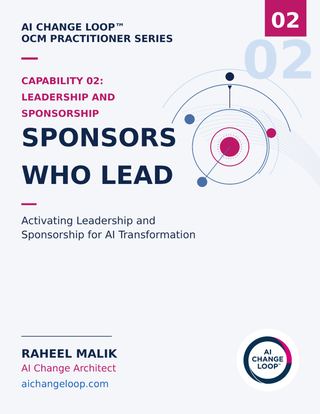
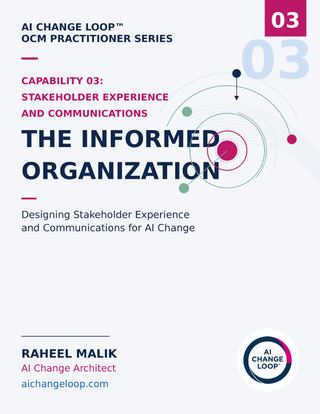
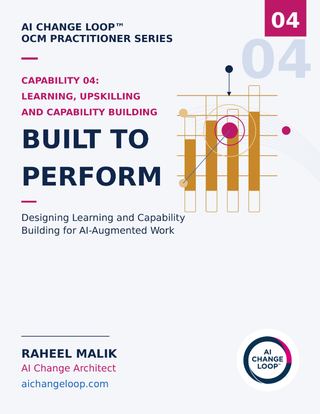
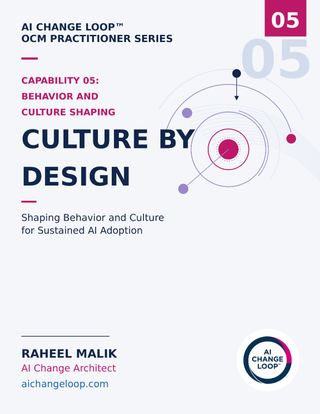
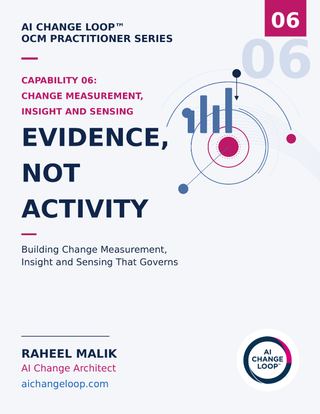
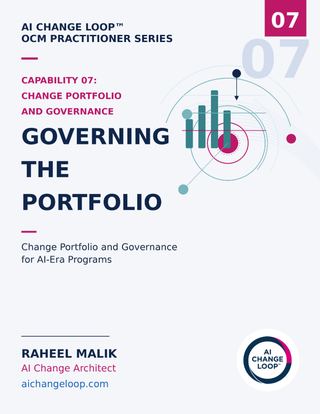
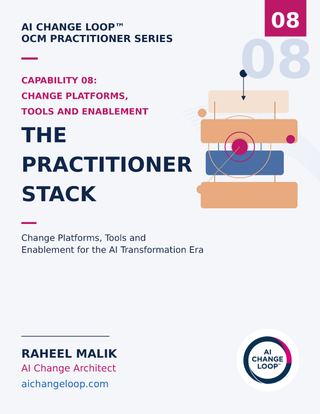
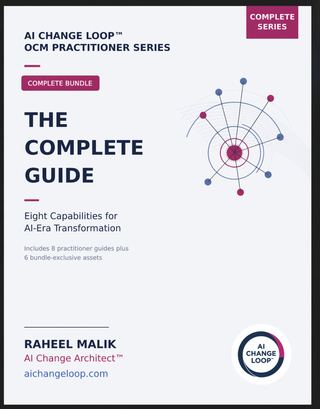
Eight capability guides plus the Complete Guide, which exists only inside the bundle. Covers shown at grid resolution; full resolution files are exported at storefront listing dimensions, register item C10.
What is actually in one
These are OCM guides, not framework theory. Each one takes a single capability through a live programme from Discover to Run, and names the artifacts, the tools and the team you need at each point.
Phase by phase, not chapter by chapter
The middle of every guide follows one programme through six phases. What the capability is doing in Discover is not what it is doing in Deploy, and the guide is organised around that rather than around theory.
- Discover: what gets designed before anything is built
- Prepare and Explore: infrastructure, then calibration in the sprint cycle
- Realize: validation before the go-live gate
- Deploy and Run: going live, then governing through it
Artifacts, tools and what you actually produce
Each guide names the instruments in practice, the AI tools and the digital tools that suit the capability, and the work products you are expected to produce. Naming the technology is deliberate. A capability guide that never mentions what you build it with is an essay.
- Instruments in practice, with worked output examples
- AI tools and digital tools, named and positioned
- Work products, with a full artifact inventory in the closing
- A governance and reporting calendar you can run from
Governing up, across, through and out
The stakeholder architecture is treated as four distinct directions, because sponsoring upward, integrating sideways, enabling practitioners and handling country or regional variation are four different problems that most OCM material collapses into one.
- Governing up: what the steering committee actually needs
- Governing across: integration with the other workstreams
- Governing through: practitioners doing the work
- Governing out: regional and country level variation
Failure patterns, resistance and what healthy looks like
Every guide carries named failure patterns for its capability, the resistance you will meet, a risk register, and a description of what good actually looks like so you can tell the difference.
- Three named failure patterns per capability
- Resistance patterns and how they present
- An OCM risk register for the capability
- Sustainability: what happens when the programme ends
Each guide teaches the instrument architecture: what an instrument is for, how it is structured, what it produces, and how its output maps into the continuous performance signal. It does not reproduce the instruments themselves. The surveys, scoring rubrics, question sets and templates are activated inside the platform, because an instrument handed over as a document is a template, and an instrument run inside the platform is a measurement. Stating this openly is the point. You should know what you are buying before you buy it.
Built to be used, whatever size you are
Team sizing and resourcing
Each guide gives resourcing guidance for the capability, so you can staff it rather than guess at it.
Scaling to smaller programmes
Not every organisation is running an eighteen country transformation. Each guide has a section on what to keep and what to drop.
Your first thirty days
A starting sequence for a practitioner picking the capability up cold.
Start with the framework
The framework page carries the architecture the books teach, at no cost.
Loop Insights
Framework implementation, the Orien case work, and the questions worth putting to a steering committee. Published openly.
Read the insights